Advice November 29, 2026, 4 minute read
What a charging system warning means, and the 3 problems behind it
A battery light or "charging system" message means the car has stopped recharging its battery. What fails, how far you can drive, and how we test it.
A battery light on the dash, or a message like "check charging system" or "12 volt charging system problem", nearly always means the same thing: the car is no longer recharging its battery while it runs. A bad charging system doesn't stop the car right away. It runs on whatever is left in the battery, and then it quits.
What the charging system does
The battery starts the engine. After that, the alternator takes over. It's turned by a belt off the engine and makes the electricity for the lights, the fuel pump, the computers and everything else, while topping the battery back up. A healthy system holds about 13.5 to 14.5 volts with the engine running. A fully charged battery sits near 12.6 volts with the engine off.
1. A worn-out alternator
This is the most common cause. Alternators often last 7 to 10 years, and heat and miles wear out the bearings, brushes and diodes inside. The signs:
- Headlights that dim at idle and brighten when you rev the engine
- Slow power windows or a weak heater fan
- A whine or grinding noise from the front of the engine
- A battery light that flickers on at stoplights
2. A weak battery
Most car batteries last 3 to 5 years, and Michigan winters are hard on them. A cold battery has much less cranking power, which is why a battery that worked in September gives up on the first 10-degree morning. A failing battery can also set a charging warning, because the alternator can't bring it back up to voltage. The signs:
- Slow cranking, mostly on cold mornings
- White or green crust on the battery terminals
- A battery case that looks swollen
3. The belt, cables and connections
Sometimes the alternator and battery are both fine and the power just isn't getting through. A slipping or broken drive belt means the alternator isn't spinning. Loose or corroded battery terminals, a bad ground strap or a blown main fuse will do the same thing. These are the cheapest fixes, so we check them first.
How far can you drive with the warning on?
Not far, and there is no way to know exactly. Many cars will run less than an hour on the battery alone, and less than that at night with the heater and wipers on. Switch off what you don't need, such as heated seats and the rear defroster, and head for a shop instead of home. If a shop isn't close, park somewhere safe and call for a tow, because a car that stalls in traffic also loses its power steering. If the steering also gets heavy or the temperature gauge starts to climb, the belt has probably broken. Pull over and shut the engine off.
How we test it
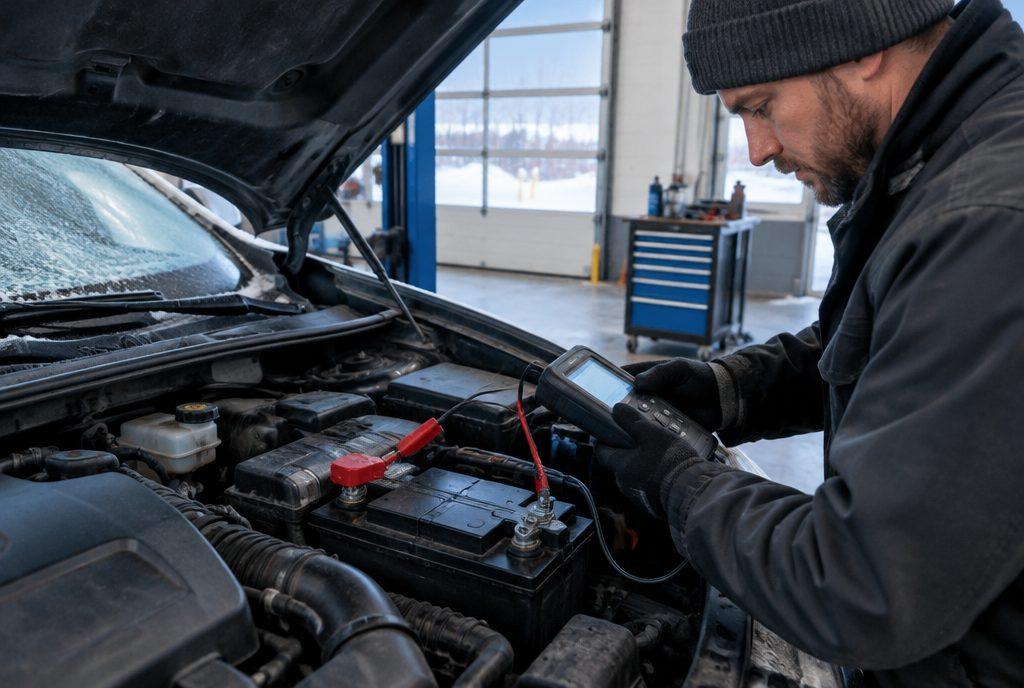
The battery test is free at all 8 Redford Auto Repair shops. We test the battery under load, measure what the alternator puts out, and look over the belt and connections, so you replace the part that has failed and not the one next to it. You get a written price before any work starts. If the car won't make it in, towing is free within 5 miles on a repair of $250 or more.